Most Tustin families assume kindergarten means one thing: the neighborhood elementary school in August. But a private kindergarten year (like the one at Newport Ave Preschool & Kindergarten) is a genuine alternative path through the same milestone, with smaller classes, a full working-day schedule, and a year-round calendar. It isn't better or worse than public kindergarten in the abstract; it's a different shape, and it fits some children and some family logistics dramatically better. Here's what the year actually covers and how to think about the choice.
Key takeaways
- •Private kindergarten teaches the same core standards public kindergarten does (reading foundations, math, writing) the state's expectations don't change with the building.
- •The structural differences are class size, hours, and calendar: smaller groups, a 6:30 AM–6:00 PM day, and no nine-week summer gap.
- •First grade the following year works identically either way; children enroll in public first grade from private kindergarten routinely.
- •The fit cases: working families who need the full-day coverage, children who thrive with more adult attention, and kids continuing from the same campus's pre-K.
- •Ask any private kindergarten the same hard questions you'd ask a school: curriculum specifics, teacher background, and how they hand off to first grade.
What does a private kindergarten year actually teach?
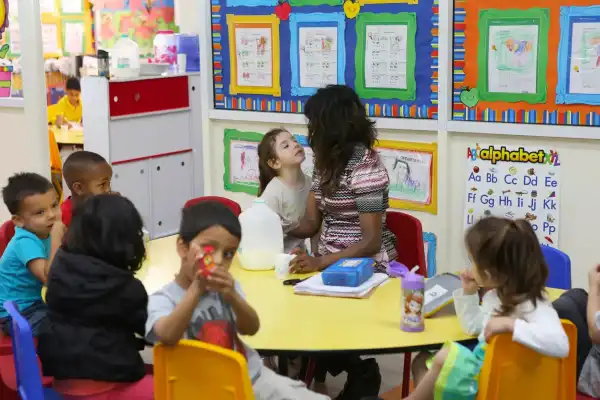
The same academic core as any California kindergarten; because first grade's expectations are the same regardless of where the kindergarten year happened. The reading foundations: letter-sound fluency, decoding simple words, sight vocabulary, and the comprehension work of retelling and predicting. Math: counting and cardinality deep into the double digits, addition and subtraction within ten with objects and fingers and eventually numerals, shapes, patterns, and measurement by comparison. Writing: name mastery long past, then sentences with invented spelling marching toward conventional, and the fine-motor stamina to fill a page. Science and social studies arrive as themes and projects. What a smaller class changes isn't the list; it's the delivery: a kindergarten teacher with a smaller group can hear every child read every week, catch the letter-reversal pattern in October instead of February, and stretch the child who's sprinting while supporting the one still consolidating. The question to ask on any tour is not "do you cover the standards" (everyone says yes) but "show me how you track each child against them", and the answer should look like portfolios, running records, and specifics.
How is the day and year shaped differently?
Around a working family instead of a school district. The structural facts: the day runs 6:30 AM to 6:00 PM; the academic core in the morning and early afternoon, wrapped in the same before-care and after-care that the preschool rooms enjoy, with no separate aftercare program to find, enroll in, and drive to. The year runs year-round; no nine-week summer gap, no spring break scramble, no teacher in-service days that appear on no employer's calendar. For a dual-working household, that's the entire value proposition in two sentences: one enrollment covers the whole day and the whole year, and the kindergarten year (often the hardest childcare-logistics year of all, because school hours shrink just as children age out of full-day care) becomes logistically identical to the preschool years that preceded it. The summer question deserves its own note: instead of losing ground over a long break (the summer-slide research is real for this age), the year-round rhythm keeps skills compounding, with summer's lighter texture carrying the same learning in sunscreen.
Will my child transition to public first grade smoothly?
Yes; this is the question every family asks and the answer is genuinely reassuring. Children enroll in public first grade from private kindergartens routinely; districts enroll by age and residence, first-grade teachers receive children from every kindergarten configuration each fall, and what carries is what always carries: reading foundations, number sense, writing stamina, and the classroom citizenship of following directions, working in groups, and managing belongings. A well-run private kindergarten aims its whole year at exactly that handoff; ask how the curriculum maps to what local first grades expect, and expect a specific answer. Two practical notes for the transition: keep records (the kindergarten's year-end assessment and portfolio travel well, and first-grade teachers appreciate them), and register with your district in the spring window like any incoming family. The child who walks into public first grade from a small private kindergarten typically walks in reading-ready and group-seasoned; the adjustment is the bigger campus and the new faces, which children handle the way they handle every school transition: wobbly for two weeks, then fluent.
Who does private kindergarten fit best, and who should skip it?
The fit cases are concrete. The logistics case: two working parents facing a public kindergarten day that ends in the early afternoon, with aftercare waitlists and a district calendar full of gaps; the full-day, year-round shape solves the whole problem in one enrollment. The attention case: a child who benefits measurably from smaller groups; the quiet one who disappears in a crowd of 24, the wiggly one who needs more adult proximity, the advanced reader who needs stretching; gets more of a teacher's bandwidth in a smaller room. The continuity case: a child already thriving at the same campus's pre-K keeps their teachers, friends, routines, and yard for one more foundational year, and the school's cumulative knowledge of the child keeps compounding. Who should skip it: families whose neighborhood school is the social hub of their street and whose logistics fit its hours; the free public year plus the neighborhood cohort is a genuinely great deal when the shape fits your life. Visit both, run your real Tuesday against each schedule, and let the child's profile and the family calendar decide. Both roads lead to first grade with a prepared kid.
Frequently asked questions
Is private kindergarten legally equivalent to public kindergarten?
Kindergarten isn't mandatory in California at all; first grade enrollment runs on age. A private kindergarten year satisfies every practical expectation first grade has; there's no equivalency paperwork to worry about.
What are the class sizes?
Smaller than typical public kindergarten rooms; ask for the current numbers on a tour and count heads yourself while you're here.
Can my child start kindergarten here without having attended the pre-K?
Yes; the kindergarten enrolls new families each year alongside continuing ones. A readiness conversation and a visit sort the fit quickly.
Does the year include the specials; art, music, STEAM?
The dual-language STEAM curriculum and enrichment blocks run through the kindergarten year the way they do through pre-K; ask to see the weekly schedule on your tour.
Weighing kindergarten options for next fall? Tour ours mid-morning and watch the reading groups run. Call (714) 730-3424, Newport Ave Preschool & Kindergarten in Tustin.